Ask any yarn mill owner what keeps them up at night. You’ll hear the same things. Cotton prices jump. Yarn comes back for count variation. Nobody knows the real cost per kg.
Most of these problems start in the same place: your data is scattered across Excel sheets, registers, and people’s memory.
This guide covers 10 real challenges in the yarn manufacturing industry and shows how ERP helps with each one. You’ll also learn what to look for in the best ERP software for yarn manufacturing in India, and which mistakes to avoid before you buy.
Why the Yarn Manufacturing Industry Needs One Source of Truth
A spinning mill isn’t a simple assembly line. fiber moves through the blow room, carding, drawing, spinning, and winding. Every stage creates waste and has its own numbers.
When those numbers sit in separate files, you find problems late. Often after the yarn has already shipped.
An ERP brings purchase, stock, production, quality, sales, and accounts into one system. Everyone sees the same figures. That’s the whole idea, and everything below builds on it.
The same applies across the wider textile and yarn industry. Weaving, knitting, and processing units face the same gaps between departments.
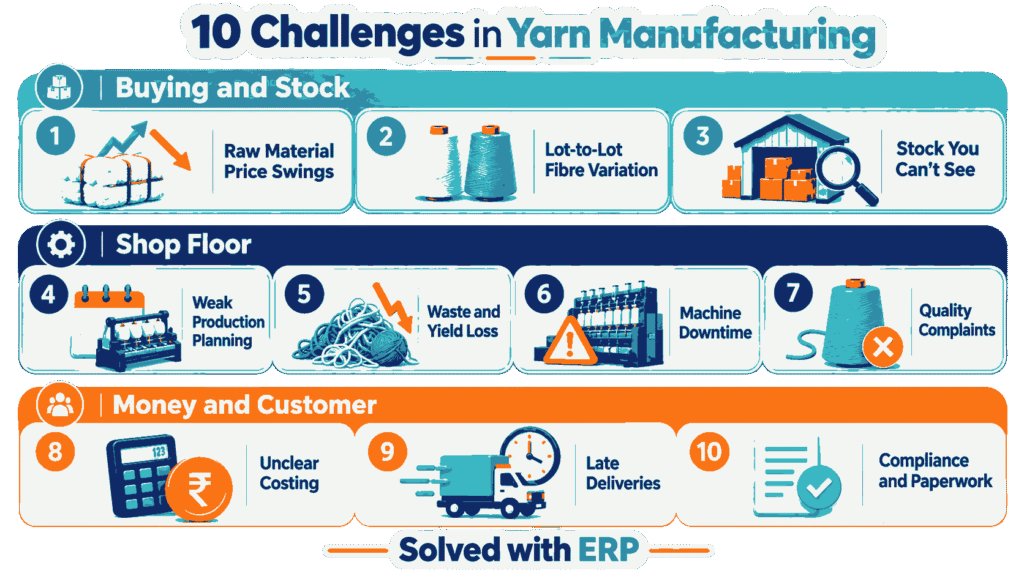
10 Challenges in Yarn Manufacturing and How ERP Solves Them
Here’s how each problem shows up on the floor, and what ERP does about it.
Buying and stock challenges
- Raw material price swings. Cotton and fiber rates change often. Buy at the wrong time and your margin shrinks. An ERP keeps past purchase rates by supplier and shows how many days of stock you hold. You buy with data, not a good feeling.
- Lot-to-lot fiber variation. Two lots can spin very differently, even from the same supplier. ERP records quality details for each lot. Your team plans mixing with facts, and any complaint can be traced back to its source lot.
- Stock, you can’t see. Bales in the godown, cones in packing, cartons at dispatch. ERP updates stock as goods move, so you stop counting by hand. You also stop running out of packing material at the last minute.
Shop floor challenges
- Weak production planning. Mixed counts, limited machines, and urgent orders collide. ERP plans by machine capacity and due date. Your planner sees clashes early, not on the day the buyer calls.
- Waste and yield loss. Comber Noil, hard waste, and sweeping waste add up fast. ERP compares input and output at every stage. You’ll see which machine or shift loses the most, and you can set limits that raise a flag.
- Machine downtime. Breakdowns often get written in a register, if at all. An ERP maintenance module schedules service and logs to each stoppage for a reason. After a few months, repeated problems became obvious.
- Quality complaints. Count variation, weak strength, and thick or thin places cost you customers. ERP links test results to the lot, machine, and shift. You catch drift early, before the yarn leaves your gate.
Money and customer challenges
- Unclear cost. Many mills know the selling price but not the true cost per kg. ERP combines fiber, waste, power, labor, and overheads into one figure per count and per order. Now you know which orders actually make money.
- Late deliveries. Buyers call to ask where their order is. ERP shows status from fiber issue to dispatch. Your sales team answers in seconds, and you spot delays before the customer does.
- Compliance and paperwork. When data is scattered across different places, it takes a lot of time to generate GST returns, e-invoices, and e-way bills. A good ERP system creates all these things from those records. Rules keep changing, so confirm the latest requirements with your CA.
A quick example: catching waste
Say your yarn output looks lower than expected. Without ERP, someone checks registers for hours and makes a guess.
With ERP, you open a stage-wise report. It shows one carding shift running higher waste than the others. You check the machine settings and the process that same day.
People still must fix the problem. But you find it much faster.
What Makes the Best ERP Software for Yarn Manufacturing in India
Generic ERP tools often need heavy Customization for a spinning mill. Look for a system built for the job. Check these points:
- Built for spinning. It should understand counts, blends, lots, waste types, and cone or bag packing.
- Stage-wise yield tracking. You need numbers from blowing room to winding, not just final output.
- Easy shop floor entry. Simple screens for operators, or machine integration where your setup allows.
- Indian compliance. GST, e-invoicing, and e-way bill support should be part of the system.
- Owner dashboards. Daily stock, production, and cost on your phone.
- Room to grow. If you add weaving or knitting later, the system should stretch with you.
One honest note: no software is best for everyone. The correct choice depends on the size of your mill the number of people you have and how your team is working now.
How to Choose ERP for Textile Manufacturing Industry?
Choosing the ERP for the textile industry in India needs a clear plan. I have a plan for you.
- Write down your top five pain points. Waste, cost, and stock are starting points for the textile industry.
- Ask for a demo with your data. Use an order, like a 30s combed cotton lot and watch that ERP move from purchase to dispatch.
- Talk to a mill. Ask a user what went wrong during rollout, not just what went well with ERP.
- Ask about migration and training. Old data needs cleaning. Operators need practice. Get a go-live plan with dates for ERP.
- Get all costs in writing. License, customization, training, and yearly support for ERP.
Picture a manager who finds out at month-end that a popular count lost money for three months. A demo built on orders would show that gap in the first week.
Common Mistakes to Avoid
These slips show up again in textile manufacturing industry projects.
- Buying on price alone. A cheap system that doesn’t fit your process costs more later.
- Skipping training. If operators don’t trust the screens, they’ll go back to the paper.
- Going live everywhere at once. Start with stock and production. Add cost and quality next.
- Ignoring old data. Wrong item names and duplicate parties will follow you into the new system.
- Expecting magic. ERP shows problems clearly. It can’t fix worn machines or poor buying habits on its own.
Conclusion
Yarn margins are thin, so small leaks add up. The right ERP helps you see waste, cost, and delays before they hurt your business.
If you’re comparing the best ERP software for yarn manufacturing in India, start with your own pain points. Then ask for a demo built around your mill’s real orders.
Pick one problem from the list above and start there.
Want to see how this works in a real spinning mill? Book a free Demo with Cloudmonte Technologies Pvt. Ltd. and we’ll run one of your own orders through the system, from fiber purchase to dispatch.